Sustainable Sara: EPR Is Reshaping the Plastics Value Chain: Why Third-Party Verification Matters More Than Ever
Extended Producer Responsibility (EPR) is fundamentally changing how the plastics industry approaches product stewardship. While much of the conversation has focused on producer fees and packaging reporting obligations, a much larger shift is underway.

EPR Is More Than Compliance
Across the plastics value chain, companies are being asked to do more than simply make sustainability claims, they are expected to demonstrate that those claims are supported by credible, traceable, and independently verified evidence.
As a Certification Officer, I've seen a noticeable evolution over the past several years. Questions that once centered around "Can we claim recycled content?" have become "How do we prove it?"
That distinction is significant.
As EPR regulations mature, recycled content mandates expand, and environmental marketing claims receive greater scrutiny, documentation has become just as important as the recycled material itself. Achieving a recycled content target is only part of the challenge.
Organizations must also be able to demonstrate:
how that material was sourced
how it was tracked through the supply chain
how recycled content percentages were calculated
what objective evidence supports every claim
Regulators, retailers, customers, and certification bodies are increasingly evaluating not only the environmental outcome, but also the integrity of the systems used to substantiate it.
This shift places greater importance on traceability, chain of custody, supplier documentation, and independent verification. Companies that build these capabilities into their operations today will be better prepared to meet evolving regulatory requirements while strengthening the credibility of their sustainability claims.

Straight Talk from Sara
The recycled content conversation has matured. It is no longer enough for a company to know what it purchased or what it intended to use. Organizations need to be able to show how recycled material was identified, controlled, calculated, and supported with objective evidence throughout the process.
The Verification Ecosystem
One of the biggest misconceptions surrounding EPR is that there is a single certification that demonstrates compliance.
In reality, EPR today is an ecosystem of regulatory obligations, reporting requirements, material traceability, and claim substantiation. Different organizations within the packaging value chain have different responsibilities, and verification plays a role at multiple stages.
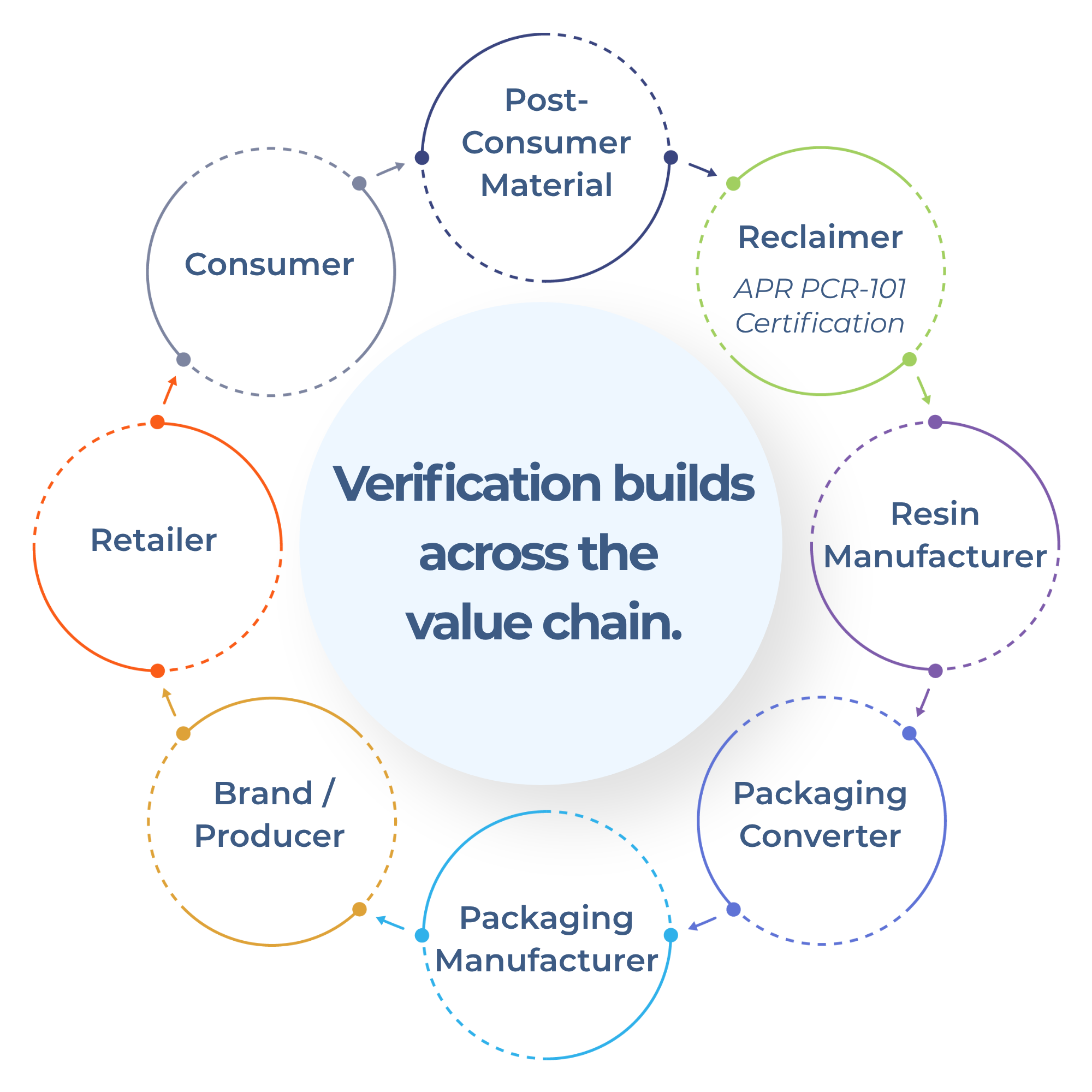
Think of verification as an ecosystem rather than a single event.
Each step builds upon the integrity of the one before it. Independent verification at the beginning of the supply chain establishes a credible foundation that supports confidence throughout the manufacturing process.
When reclaimed resin is independently verified, downstream manufacturers have stronger evidence regarding the recycled content of the materials they purchase, reducing reliance on supplier declarations alone. As those materials are incorporated into packaging and finished products, additional documentation, chain-of-custody controls, and product-level verification may build upon that foundation to substantiate broader environmental claims.
In this way, verification is not a single event. It is a continuous process that strengthens transparency, traceability, and confidence as materials move from reclamation to the final product.
From Documentation to Traceability
Historically, recycled content discussions focused primarily on achieving a target percentage. Today, organizations must also demonstrate that the percentage can be substantiated.
One of the most common misconceptions is that documentation alone proves traceability. But in reality, invoices, supplier declarations, and production records are only pieces of evidence. They must support a documented system that demonstrates how recycled material is sourced, tracked, allocated, and incorporated into the finished product.
Companies that invest in strong traceability systems, supported by accurate documentation and independent verification, will be better prepared to meet regulatory expectations and defend their sustainability claims.

Sara Says: It’s More Than a Paper Trail
Documentation matters, but documentation is not the same as traceability. Strong traceability connects records to a defined system. That system should show how material moves through the process, how quantities are reconciled, and how recycled content calculations are supported.
Where APR PCR-101 Fits
One important component of this verification ecosystem is the Association of Plastic Recyclers (APR) PCR-101 Certification Standard.
APR PCR-101 provides independent verification of greater than 90% post-consumer recycled plastic resin produced by reclaimers. The certification evaluates recycled content, material traceability, supporting documentation, and chain-of-custody controls to verify the integrity of PCR resin entering the marketplace.
Although the certification applies specifically to reclaimers, its value extends throughout the downstream supply chain.
Packaging converters, packaging manufacturers, and brand owners increasingly rely on verified resin as the foundation for their own recycled content claims. Independent verification at the resin level helps establish confidence in the material before it is incorporated into finished packaging and consumer products.
Verification Doesn’t Stop at the Resin
Resin verification is only one piece of a comprehensive claim substantiation strategy.
As materials move through manufacturing, organizations may need additional verification depending on the claims they make and where they operate within the value chain.
For example, a packaging manufacturer making recycled content claims about a finished package may require product-level recycled content certification that evaluates the finished product — not just the resin inputs.
Likewise, organizations may need documented chain-of-custody procedures, supplier qualification processes, allocation methodologies, and ongoing surveillance to support customer requests, retailer requirements, or regulatory reporting.
Verification should be viewed as layered evidence that builds confidence from raw material through finished product.
EPR Readiness Requires More Than Good Intentions
Most current U.S. EPR regulations do not prescribe one specific certification program.
Instead, they require producers to maintain accurate, defensible information regarding the packaging they place on the market.
Organizations should be asking themselves:
Can we substantiate every recycled content claim we make?
Do we understand where our recycled material originates?
Are our suppliers providing sufficient documentation?
Could we demonstrate our calculations during an audit or regulatory review?
Are our internal systems prepared for evolving reporting requirements?
The companies that can confidently answer "yes" to these questions will be better positioned as EPR programs continue to mature.

Could Someone Else Follow the Breadcrumbs?
A useful way to think about EPR readiness is this: could someone outside your organization follow the documentation trail and reach the same conclusion? If the answer is unclear, there may be gaps in traceability, calculation methodology, or claim substantiation that should be addressed before reporting or customer review.
Building Your EPR Readiness Roadmap
Whether or not APR PCR Certification is the right fit for your organization, every packaging manufacturer and brand owner operating in the current regulatory environment should be working through a structured EPR readiness assessment. That means:
Mapping your regulatory exposure
Understand which EPR programs, recycled-content requirements, and packaging reporting obligations may apply based on where your products are sold, what materials you use, and your role in the supply chain.Evaluating your current tracking systems
Assess whether your supplier documentation, material traceability processes, bills of material, and recycled content data can support current and emerging reporting expectations.Reviewing your claim substantiation
Audit the recycled content claims appearing on packaging, websites, sales materials, customer documentation, and sustainability reports. Compare those claims against the documentation currently available to support them.Determining your verification needs
Identify the gaps between what you are claiming and what you can currently prove. Then determine whether resin-level verification, product-level certification, supplier documentation, chain-of-custody review, or a combination of approaches is appropriate.Preparing for future requirements
Build the data management, reporting, and audit-readiness infrastructure that will be needed as EPR programs mature and disclosure requirements expand.

Sara's Closing Thought
The regulatory landscape surrounding packaging sustainability continues to evolve rapidly.
While specific EPR requirements differ by jurisdiction, one trend is becoming increasingly clear: expectations for data quality, transparency, and claim substantiation will continue to grow.
Organizations that build verification into their supply chains today will be better positioned not only to meet regulatory obligations but also to respond to customer requests, retailer expectations, and future sustainability initiatives.
Verification should not be viewed as the end of the compliance process. It should be viewed as the foundation of trustworthy environmental claims.

Frequently Asked Questions
Who benefits from APR PCR-101 Certification?
APR PCR-101 is designed for post-consumer plastic reclaimers. However, packaging converters, resin manufacturers, packaging manufacturers, brand owners, and retailers all benefit from greater confidence in independently verified recycled resin entering the supply chain.
Why is third-party verification becoming more important?
Regulators, retailers, procurement teams, investors, and consumers increasingly expect sustainability claims to be supported by objective evidence. Independent verification improves confidence in recycled content claims by validating documentation, calculations, and traceability.
What is the difference between resin-level and product-level verification?
Resin-level verification confirms the recycled content of the raw material entering the manufacturing process. Product-level verification confirms the recycled content of the finished product or package being sold. Depending on where an organization operates within the value chain, one or both forms of verification may be appropriate.
Will EPR regulations eventually require third-party certification?
While current U.S. EPR laws generally do not mandate a specific certification program, regulatory expectations continue to evolve. Many organizations are proactively implementing independent verification to improve data quality, reduce compliance risk, and prepare for future reporting and documentation requirements.
About Sustainable Sara
Sustainable Sara is GreenCircle Certified's in-house certification officer and your go-to source for navigating sustainability claims, audits, and emissions reporting. She's deeply knowledgeable, fiercely passionate about environmental integrity, and believes that every company — no matter the size — can make credible, verifiable sustainability progress.
Connect with Sara at SustainableSara@greencirclecertified.com