Why Stronger Supplier Partnerships Can Make EPR Compliance Easier
When I connect with a client who's just starting their extended producer responsibility (EPR) journey, I ask them to do one thing first: stop thinking about compliance and start thinking about relationships.
EPR programs shift responsibility for packaging from the public sector to the companies that put it in the market, requiring producers to help fund and manage its collection, recycling, and reporting.
Reframing EPR as relationships means it’s not a form you fill out once a year. It’s a system — a living network of suppliers, producers, consumers, haulers, and recyclers, all passing material and data back and forth. A Producer Responsibility Organization (PRO) helps coordinate that network by managing producer participation, fees, program implementation, and reporting. When one link breaks down, the data and documentation become much harder to manage:
Suppliers to producers
Producers to consumers
Consumers to waste haulers
Waste haulers to recyclers
How the EPR System Connects
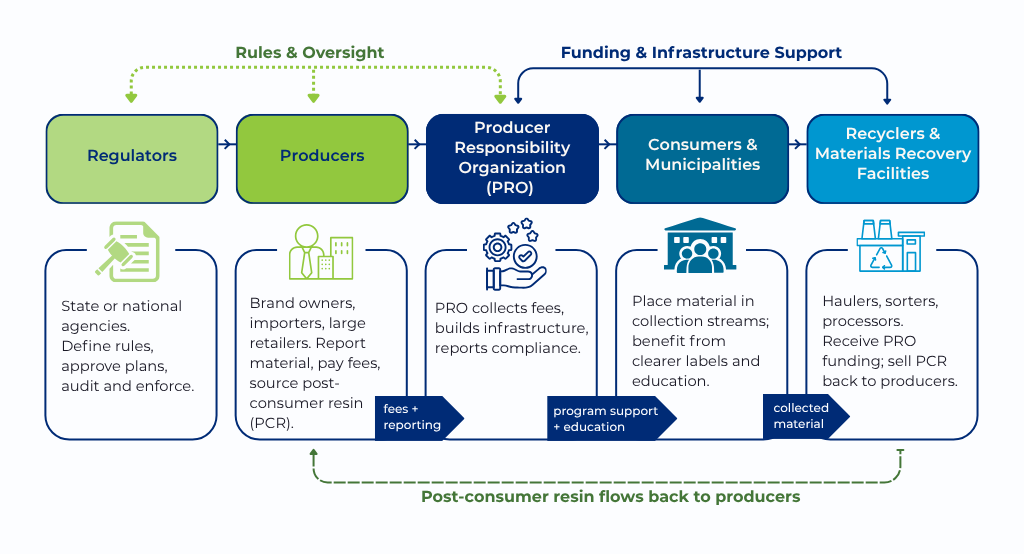
EPR is building an ecosystem that creates partnership opportunities up and down the value chain. The teams who treat it that way will have a much smoother time than the teams who treat it like required paperwork.
Why Supplier Relationships Matter for EPR Compliance
If you're a producer, your relationship with your suppliers can be one of the biggest factors in whether your EPR data is complete and usable. As a producer, you're responsible for accurate registration and reporting — but the data for that reporting almost always lives with your material and packaging suppliers. Getting the data in a clear, organized, and usable format? That's the hard part, especially if the relationship has historically been transactional.
Here's a sense of what you may be asking suppliers to provide:
Packaging composition and specifications
Recycled content or dematerialization declarations
Bill of materials or product recipes
Weight substantiation, including engineering drawings, test reports, or scale measurements
Sales data — units shipped, dates, brands, facility of origin and destination
Recyclability documentation
Third-party verification, where applicable
That's a lot to ask of a supplier who may not fully understand why you need it. Which brings us back to the relationship.
Make It Easier for Suppliers to Help You
On the supplier side, fulfilling EPR reporting requests usually means coordinating with packaging engineers, production managers, sales and procurement teams, regulatory teams — and often their own upstream and downstream partners. It's not a single email; it's a small internal cross-functional project.
The most useful thing a producer can do is engage early. Tell your suppliers what you need and why. Offer your support as you ask for theirs. Here are a few worthwhile questions to open the conversation:
Do you already track this data, or will it need to be pulled together?
Who internally owns each piece — composition, weight, recycled content?
Have you had this data verified by a third party before?
What would make this easier for you next time?
Teams that ask these questions early can avoid the scramble that happens when a reporting deadline is two weeks away, and the data still isn't in hand.
How Third-Party Certification Supports EPR Compliance
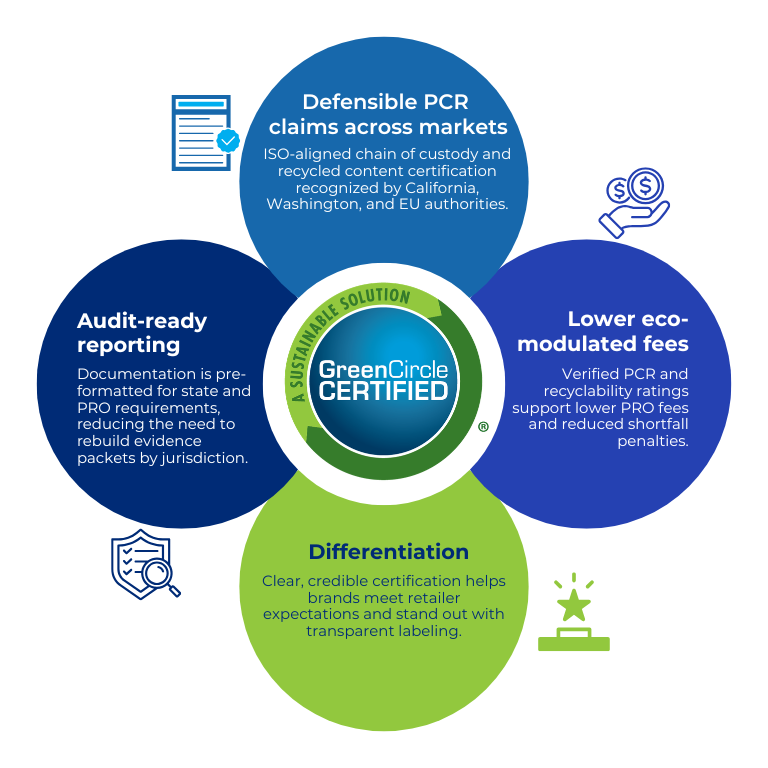
For suppliers, this is why third-party certification is so important. When a producer asks for this level of detail, being able to provide an independent recycled content certification — backed by reviewed material documentation, chain-of-custody information, and supporting production data — says something. It tells your customer you're prepared, credible, and ready to be a trusted partner. And depending on the jurisdiction, it can also open the door to eco-modulation fee reductions.
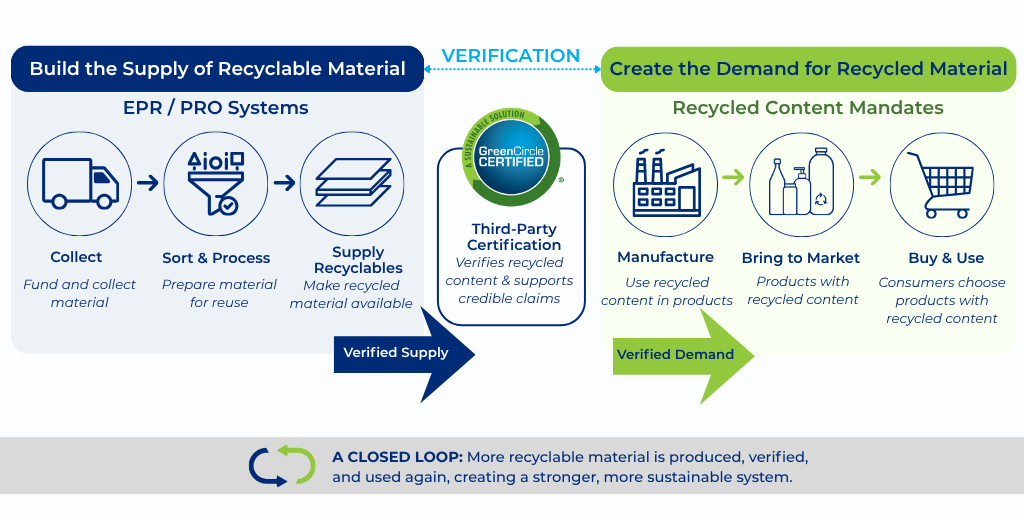
How Third-Party Certification Closes the Loop
EPR programs help increase the collection, sorting, and processing of materials, creating more recycled feedstock (supply). At the same time, recycled content mandates and corporate commitments create demand for that material.
Third-party certification helps connect the two by providing trusted, verifiable proof that recycled content is accurately measured, documented, and traceable. Verification strengthens that connection by giving producers and their customers greater confidence in the material and data moving through the system.
The Ecosystem Relies on Relationships and So Does Your Compliance
If there's one thing I want you to take from this, it's that EPR compliance isn't really a solo activity, even though the reporting obligation may land on one company's shoulders. It's a collaborative effort that runs the length of the supply chain.
In my experience, some of the biggest EPR challenges arise when supplier relationships aren’t built until the data is already due. The ones who navigate it smoothly start those conversations early, ask good questions, and treat their suppliers as partners rather than vendors.
Strengthen these relationships, and the rest of the work — the data collection, the verification, the reporting — gets a lot more manageable. And that’s a good place to build from.
Meet the Expert
Dan Lazarus, MBA

Dan Lazarus is a Senior Account Manager at GreenCircle Certified, where he works closely with clients navigating the practical side of third-party certification. His background spans sustainability consulting, scientific analysis and technical training, and strategy, giving him a first-hand view of how organizations translate complex sustainability requirements into actionable programs. He holds an MBA in Sustainable Innovation and a B.S. in Environmental Studies from the University of Vermont. He's based in Washington state, where the Pacific Northwest provides plenty of good trails for thinking through problems.